

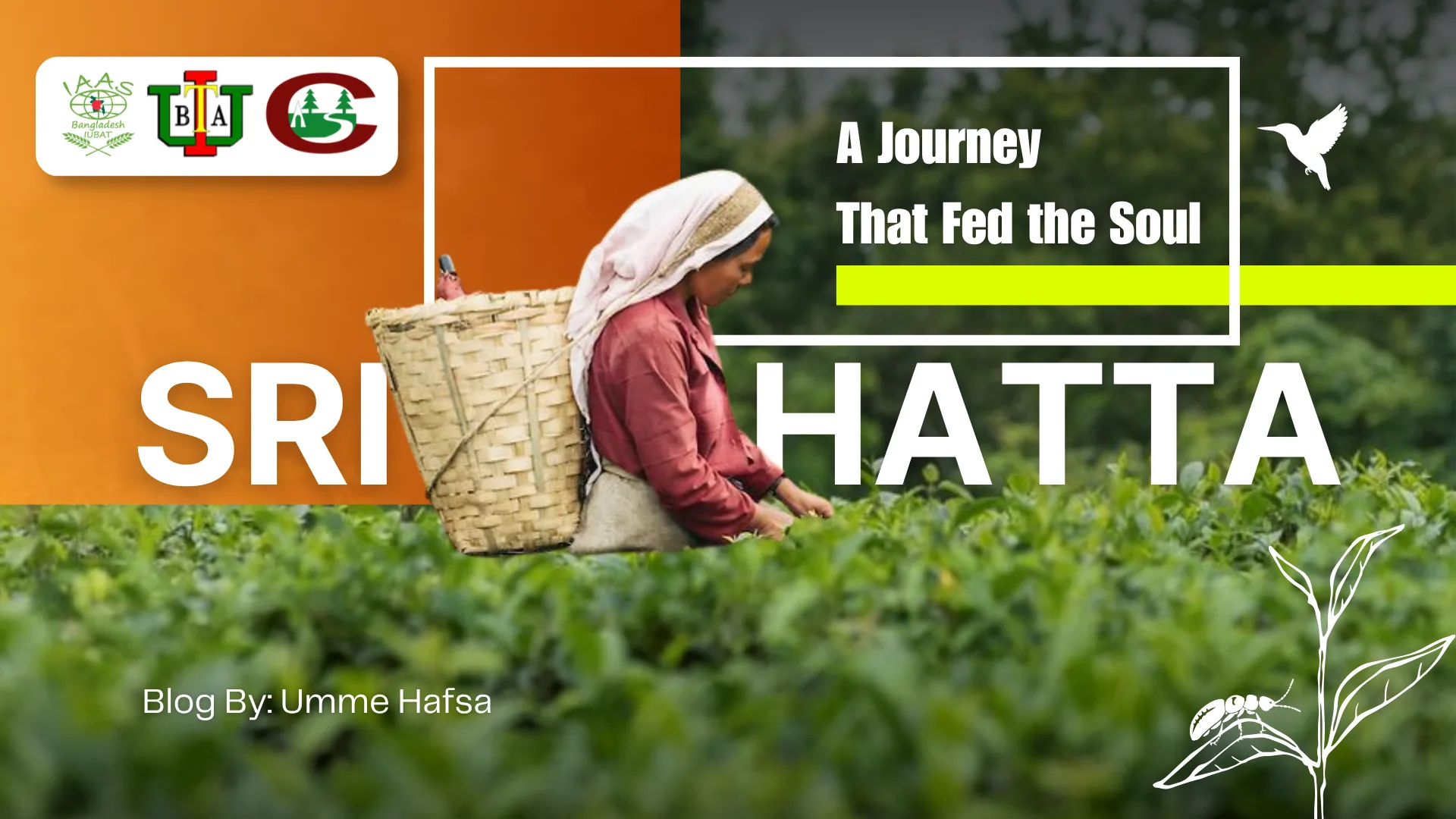
Some trips are planned. Some trips are needed. This one was both.
After a week of lectures, assignments and the particular exhaustion that only university life can produce, a group of us from International Association of students Agricultural and related Sciences Bangladesh, IUBAT boarded a bus on the night of July 15th, Wednesday destination: Sylhet: The city of tea gardens, blue rivers, ancient forests and spiritual history. Known across Bangladesh as the country's spiritual capital, sitting gracefully on the banks of the Surma River. But let me be clear about something from the very beginning. This was not just a holiday. This was an Eco Adventure and that word carries real weight. Bangladesh's most breathtaking natural destinations are under silent, continuous threat. Plastic waste chokes the rivers. Unmanaged tourism erodes ecosystems that took centuries to build. Biodiversity disappears not dramatically, not overnight, but quietly and irreversibly, while people are busy taking photographs in front of it. IAAS Bangladesh, IUBAT came to Sylhet with a clear, non-negotiable mission:
To see these places. To clean these places. To protect these places. And to inspire others to do the same. We did not come as passive tourists. We came as students of agriculture and environmental science people who understand, perhaps more acutely than most, exactly what is lost when a natural ecosystem collapses. Every destination on this itinerary was chosen deliberately. Every action taken there was intentional. his is the story of that intention.
We left from outside the university at around 11 PM. A normal person on a night bus might sleep. We are not normal people. What followed was a full night of stories, shared snacks, impromptu singing, chaotic dancing and then, at exactly 1 AM, everything stopped. Because Argentina vs England was playing. FIFA World Cup Semifinal. On someone's phone, projected to a crowd of sleepless, overexcited agriculture students crammed into a moving bus. The tension was unbearable. The noise was worse. And then — Argentina won. My team. My people. I won't pretend I was calm about it. By 8 AM, we were in Sylhet. Hotel check-in, a quick freshen up, and we were already moving again. Sleep is optional when adventure is on the schedule.
Malnicherra Tea Garden — Where History Grows Green
Our first stop was Malnicherra Tea Garden and not just any tea garden. This is the first established tea garden in the entire Indian subcontinent, founded in 1849 by Lord Hudson across approximately 1,500 acres of land. Every cup of tea you have ever drunk from this part of the world traces its lineage, in some way, back to this place. Getting off the bus, we crossed a small stream and stepped into another world entirely. Endless rolling green. The particular silence of a place where the air itself feels filtered. I stood there for a moment just looking the kind of looking you do when you are genuinely speechless.
And then before the pure tourism could take over entirely Sourav Kanti Bala, Research and Project Development Officer of IAAS Bangladesh, gathered everyone for a quiz session right there among the tea bushes. The questions weren't trivial. They covered Sylhet's geography, its tourist significance, its environmental challenges how these sites can be preserved, how pollution can be prevented, what responsible tourism actually looks like in practice.

This was intentional. Before we explored a single destination as tourists, we sat with the question of what it means to be a responsible one. The first five winners walked away with books. The rest of us walked away with something less tangible but more lasting a framework for how to look at everything that followed. Somewhere inside Malnicherra also lies Horang Hurang an ancient cave tucked into the more remote sections of the garden, a place that deserves its own dedicated trip entirely. Group photos, green everywhere behind us and we were back on the bus.
Ratargul Swamp Forest — The Amazon of Bangladesh
Next came Ratargul one of only 22 freshwater swamp forests in the entire world, spread across 3,325 acres in Gowainghat Upazila, Sylhet. The Bangladesh government declared 504 acres of it a wildlife sanctuary in 1973. It shelters over 73 plant species Koroch, Hijal, Borun, Kadam, Murta, Arjun, Chatim among them along with monkeys, monitor lizards, countless bird species and fish found nowhere else in the country. In monsoon season, when the Goain River rises, the entire forest submerges under 20 to 30 feet of water. The treetops poke above the surface. The forest floor disappears. The only way to move through it is by boat gliding between half-submerged trunks, beneath a canopy that doesn't know or care that it is standing in a river. It is one of the most surreal, most beautiful things Bangladesh has to offer.

We hired boats and went deeper in. The forest closed around us. And then our boatman started singing — "Nithur Manohor" — slow and mournful, floating across the water. The sound of oars. The sound of water. The sound of a voice in an ancient forest. Spiritual is the closest word I have. But here is what we also saw — and what we couldn't ignore. Ratargul is suffering. Unregulated tourism, noise pollution, plastic waste thrown from tourist boats and the slow encroachment of human activity on its edges are damaging an ecosystem that took centuries to build. A forest this rare — one of twenty-two in the world — deserves to be treated as the irreplaceable treasure it is. Not a backdrop for Instagram. Not a dumping ground. A sanctuary. In the truest sense of that word.
We moved through it quietly, with the respect the place had earned.
Bholagonj Shada Pathor — Where the River Carries Marble
Bholagonj, in Companiganj Upazila, Sylhet white stones carried down from the Meghalaya hills of India by crystal-clear river water, spread across a vast open riverbed. Blue-green, transparent water running between them. Hills in the distance. One of Bangladesh's most visually extraordinary natural sites. We took a boat from bholagonj Ghat to reach the main stone area. And this is where the heart of our Eco Adventure revealed itself most clearly. The Mission in Action — Eco Adventure at Volagonj
This moment right here, at bholagonj was the core purpose of the entire trip. Not the sightseeing. Not the photographs.
This, IAAS Bangladesh, IUBAT's Eco Adventure 2026 was built around one fundamental belief: that students of agricultural and environmental science have a responsibility that goes beyond the classroom. We study ecosystems. We study biodiversity. We study what is lost when natural environments are degraded. And then we come to a place like Volagonj one of Bangladesh's most extraordinary natural sites and we find plastic wrappers floating between white stones in a crystal-clear river.
That gap between what we know and what we find is where action must happen.
Bala Bhai assembled the IAAS Bangladesh IUBAT volunteers — and they got to work.
Waste collection at tourist sites — removing what others left behind, without waiting for permission or recognition.
Zero single-use plastic across the entire journey — reusable bottles, every member, every day.
On-site awareness — real conversations with real people about real consequences.
Education first— the quiz at Malnicherra on day one was not an icebreaker. It was a declaration: we are here to think, not just to look.
Documentation and sharing — because if this story reaches one person who thinks twice before throwing a wrapper into Volagonj's white stone river, the trip has already multiplied beyond the people on the bus.
The principle is simple: The places that take your breath away deserve to keep taking breath away — for the next visitor, for the next generation, for the next hundred years. That only happens if the people who love them decide to protect them.
The cold, clear water of the white stone river washed away every trace of tiredness. I genuinely did not want to leave. But some places are worth protecting precisely because you cannot stay in them forever.
Pathshala Ekush — Where Light Finds the Ones Who Need It Most
The next morning began with breakfast at Panshi Restaurant Sylhet's most celebrated dining institution before we made our way to Sylhet Agricultural University. Group photos at their iconic Shaheed Minar and then, in the auditorium basement beneath it, something unexpected and quietly extraordinary was waiting. Pathshala Ekush.Thirteen years old. Still going. On June 21, 2012, students from the 5th batch of SAU's Agriculture Faculty started a free school for underprivileged children, run entirely by volunteers. Their motto: "স্বপ্ন রথে, আলোর পথে" On the chariot of dreams, on the path of light."
Thirteen years later: 160+ students, nursery through intermediate level. 80+ volunteer tutors from SAU giving their time every Friday and Saturday. Annual exams, cultural programmes, health awareness campaigns. Books and stationery distributed to children who could not otherwise afford them. The results speak quietly but clearly. Students from Pathshala Ekush have achieved A+ in board examinations. One gained admission to Dhaka University. Others are studying in polytechnic and diploma institutions. From a basement auditorium and a group of young people who believed in something actual futures have been built.

Our Sabbir Shahriar Tulon, HCB of IAAS Bangladesh IUBAT, had brought chocolates and watching him and the others distribute them to the children, watching those faces light up, was the kind of moment that recalibrates something inside you. Group photos with the children. Laughter. Small hands in larger ones. Before leaving SAU, we had the honour of meeting Nazmul Hasan Arfin IUBAT alumnus (Batch 203), currently pursuing his MS at SAU (2024–25), and recipient of the prestigious Bangladesh Food Safety Authority Fellowship by the Ministry of Food— awarded to only 20 students across all universities in Bangladesh. His message to us was simple and stayed long after we left: "By the grace of Almighty Allah — focus on your goal. Develop your skills. Maintain your CGPA."
Lalakhal — The River That Chose to Be Blue
35 kilometres from Sylhet city, in Jaintapur Upazila the Lalakhal River, originating in the Cherrapunji hills of India, flowing into Bangladesh carrying something most rivers don't have: a vivid, transparent, luminous blue. The science is geological a sandy riverbed instead of mud, combined with minerals from the Jaintia hills, refracts light differently. The result looks like magic. But it is a fragile magic. The mineral balance that creates Lalakhal's blue is delicate plastic pollution and unmanaged tourism actively work to destroy it. Every bottle that enters this river is a vote against everything that makes it worth visiting.
We took boats. And somewhere in the middle of the river, the sky opened up. Rain on a blue river. Hills on both sides. Boats rocking gently. The smell of petrichor mixing with river air. We stayed. We watched. We left nothing behind.
Sangram Punji Waterfall (Mayabi Jharna) — The Enchanted Falls of Jaflong
Our final destination: Sangram Punji Waterfall Mayabi Jharna, the Enchanted Waterfall in the Jaflong area of Gowainghat Upazila, pressed against the Khasia-Jaintia hills on the Indian border, just 1 kilometre west of Jaflong Zero Point. Multi-tiered descent from the Dawki mountain range.Water pushing through green forest, cascading over enormous boulders, collecting in a natural pool below. Transparent water. The kind of waterfall that makes you stand very still and forget what you were worried about. The area is home to Khasi indigenous communities their traditional villages adding cultural depth to an already extraordinary landscape. This is not just a waterfall. It is a living ecosystem, a cultural heritage site and one of Sylhet's most fragile natural attractions all at once.
Everyone scattered in their own directions laughing, photographing, standing under the spray. Pure, uncomplicated joy. And then an accident. Our dear Naboni Apu slipped on the wet rocks and was injured. The group came together immediately. She was cared for. But it was a reminder nature, however beautiful, demands respect. These places were wild before we arrived. They will be wild after we leave. That wildness is the point. Afterwards local market. Cha pata, rice, cardamom, cinnamon. The small, domestic souvenirs of a journey worth remembering.
Satkora and the Road Home
Dinner that night was non-negotiable: beef with Satkora the iconic Sylheti citrus, giving the curry a flavour impossible to replicate anywhere else in Bangladesh. The taste of a place, carried on a plate. Then the bus. The hills giving way to flat land. Two days somehow only two days carrying the weight of a tea garden, a swamp forest, a white stone river, a children's school, a blue waterfall and an enchanted falls. By 8 AM the next morning, we were back in Uttara.
What This Trip Was Really About And Why It Matters Let me say it plainly.
Bangladesh has some of the most extraordinary natural environments in Asia. Ratargul one of 22 freshwater swamp forests in the world. Bholagonj a stone river of rare, mineral-blue transparency. Lalakhal a river whose unique colour depends on a fragile geological balance that careless tourism actively destroys. Sangram Punji a multi-tiered waterfall in a biodiversity-rich border ecosystem. Malnicherra the birthplace of an entire subcontinent's tea culture.
These places exist. Right now. They are real. They are accessible. They are magnificent. And they are all, in different ways, quietly disappearing. Not from natural disasters. Not from forces beyond human control. From us. From tourism without responsibility. From admiration without accountability. From the accumulated weight of thousands of small, careless decisions made by people who loved these places but did not love them carefully enough.
IAAS Bangladesh, IUBAT came to Sylhet with a simple but radical idea: what if the people who visited these places left them better than they found them?
Our commitments on this trip:
Waste collection at tourist sites — removing what others left behind, without waiting for permission or recognition
Zero single-use plastic across the entire journey — reusable bottles, every member, every day
On-site awareness — real conversations with real people about real consequences
Education first— the quiz at Malnicherra on day one was not an icebreaker. It was a declaration: we are here to think, not just to look
Documentation and sharing — because if this story reaches one person who thinks twice before throwing a wrapper into Volagonj's white stone river, the trip has already multiplied beyond the people on the bus
Does a group of students cleaning a riverbank for an afternoon save Bangladesh's ecosystems? No. But culture changes one small decision at a time. Tourism culture changes the same way. Someone sees a group picking up waste and thinks: maybe I shouldn't have thrown that. Someone sees reusable bottles and thinks: I could do that next time. Small shifts. Repeated. Across thousands of visitors. Across years.
That is how places survive.
Protect the places that move you. Learn about them. Clean them. Talk about them. Bring others who will do the same. Or one day and this is not dramatic, this is simply true they will not be there to move anyone. Alhamdulillah. For the journey. For the people on the bus. For the boatman who sang in Ratargul. For the children of Pathshala Ekush who smiled with chocolate-covered hands. For the blue river in the rain at Lalakhal. For the white stones of Volagonj, a little cleaner than we found them.
Come back soon, Sylhet. We weren't finished.
Written by a traveller who didn't want to come back.......................

About the author
Umme Hafsa
Documentation Officer, Quality Board Member of IAAS Bangladesh IUBAT. Collage of Agricultural Sciences, IUBAT-International University of Business Agriculture and Technology.
Related articles
Sep 01, 2026
Floating Markets in Bangladesh: Turning Waterways into Sustainable Rural Economics
Imagine setting out on a rainy-season morning and slowly leaving the familiar roads behind, only to find yourself surrou...
Aug 11, 2026
Bhawal’s Cry: From Sacred Forest to Dumping Ground?
I was born where the red earth of Gazipur meets the ancient silence of the Sal forest, and I grew up beneath the vast, s...
Jun 30, 2026
Where History Meets Wilderness: Bagerhat to Karamjol in 48 Hours
On an exhausting day, while I was napping to relieve my fatigue, I got a text from my friend,” Want to go on an educatio...