

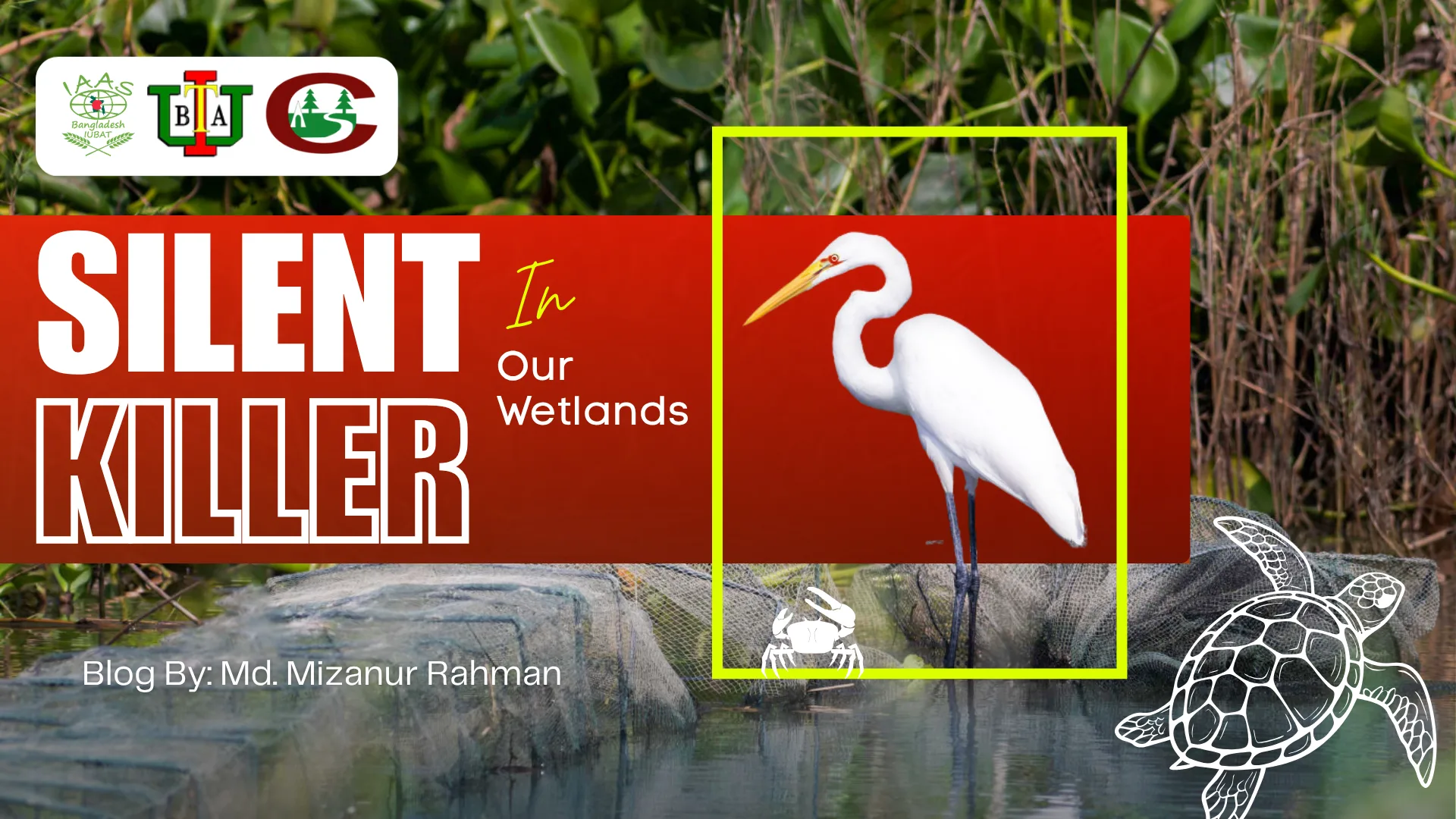
There are some places that never really leave us. No matter how far we travel or how busy life becomes, they continue to live quietly in our hearts. For me, that place is my village. I live in Uttara, Dhaka, but my heart has always remained with the village where I spent much of my childhood. During my semester break, I went back there after a long time, hoping to relive the rainy days I once loved so much. I wanted to walk beside the flooded fields, listen to the soft sound of water moving through canals, and see again the small fish that made the monsoon feel alive. But this time, something was deeply wrong. The water was still there, the rain was still there, yet the life I remembered seemed to have disappeared.
As a child, I used to think our village waters were endlessly generous. When the rains came, the canals overflowed, the beels widened, and the flooded fields shimmered like silver under the cloudy sky. We would run along the banks and watch small fish move through the shallow water. Sometimes we would spot Puti flashing near the surface, Koi hiding in the weeds, or Tengra and Taki slipping between the reeds. On lucky days, older people in the village would come home with Rui, Katla, or Mrigal, and the whole neighborhood would feel connected through the rhythm of the river. Even the smaller fish mattered to us. Shing and Magur were part of the memory of family meals, and Pabda, Baim, Bele, Bata, and Chanda made the waters feel alive with variety. Those monsoon days were not just about fishing. They were about abundance, balance, and the quiet promise that nature would keep giving if we respected it.
But when I returned this time, I felt an emptiness I could not ignore. I kept looking for the same fish I had grown up seeing, but they were hard to find. The canals felt quieter, the water felt less alive, and the silence itself seemed to say something was wrong. Soon I understood the reason behind that silence. Hidden beneath the surface was a destructive trap known as the China Duari net. Some people call it the “magic net” or “ring net,” but there is nothing magical about something that destroys an entire ecosystem for the sake of a quick catch. It is a long, fine-mesh fishing trap, often stretched over iron frames, designed to sink to the riverbed and sit flat in the water. Once it is set, it captures almost everything that passes through it. The disappearance of native fish was not just an emotional observation—it reflected a deeper ecological problem that science has been warning us about for years.
What makes the China Duari net so dangerous is not only that it catches fish, but that it catches life at every stage. Scientific and field-based reports show that this kind of fine-mesh net traps both juvenile fish and breeding adults, which means it removes the next generation before it can grow and reproduce. It also catches fish eggs, fry, aquatic insects, crabs, snails, frogs, and even water snakes, causing damage far beyond ordinary fishing pressure. When the smallest creatures disappear, the larger fish lose their food. When breeding fish are removed, the population cannot recover. When eggs and fry are lost, the future disappears before it has a chance to begin. That is why this net is not simply harmful, it is destructive at the root of the ecosystem. When wetland creatures vanish, the ecosystem becomes weaker, poorer, and more fragile.
The damage spreads through the entire food chain. Rivers and wetlands depend on balance. Tiny insects feed small fish, small fish feed larger fish, and all of them depend on clean water and natural breeding cycles. The China Duari breaks that balance by removing organisms at every level. Reports from wetlands and river areas have described serious pressure on fish eggs, juvenile fish, and broader aquatic life from this kind of illegal fishing. In places where these nets are used repeatedly, native fish become harder to find, wetlands weaken, and biodiversity slowly disappears. That is why many people now fear that fish like Rui, Katla, Mrigal, Pabda, Shol, Koi, Shing, Magur, and many other local species are becoming rare in our waters and markets. The loss is not only about one species. It is about the steady collapse of an entire living system.
Fisheries experts have warned that over 100 native fish species in Bangladesh have practically vanished from our markets, and this net is accelerating that devastating loss. Even beloved regional species, like the traditional 'Bairali' fish of the Teesta River, are now facing a severe risk of extinction. Tragically, even when fishermen discard their unwanted catch, these creatures usually die from the trauma, removing vital biological life from the ecosystem forever.

I also came to understand why people still use this net even though it causes so much harm. For many fishermen, it promises an easy and heavy catch with much less effort than traditional methods. In difficult economic conditions, that can be tempting. That short-term gain is one reason the net continues to circulate in villages and markets. Even though it is illegal under Bangladesh’s fish conservation rules, it is still found in different places and continues to be used in many water bodies. It is shockingly affordable, costing anywhere from 4,000 to 10,000 Taka depending on their size and quality. This is part of what makes the problem so painful. A destructive tool should not be so easy to find. A disturbing new trend has even emerged where unscrupulous business owners purchase these nets and hire local day-laborers simply to maximize their illegal fishing profits.
The legal side of this issue is equally frustrating. Bangladesh has rules to protect fish and aquatic biodiversity, and the China Duari net is treated as illegal or unauthorized under existing fish protection regulations. Yet public reports continue to show raids, seizures, and destruction of these nets in different districts. In places like Haluaghat in Mymensingh, local raids have uncovered warehouses storing 8,000 meters of China Duari nets alongside current nets worth 20 lakh Taka, resulting in fines and jail time for the culprits. Similarly, in Chatmohar, Pabna, task forces have seized and publicly burned these nets to send a strict message to the community. These actions prove that enforcement exists, but they also show that the problem keeps returning. The supply chain remains highly active, often because local administrations struggle with manpower shortages to conduct daily drives. If the supply chain were truly broken, the same harmful gear would not keep appearing again and again.

This is why the real solution must go deeper than blaming only the fishermen. Many of them are driven by poverty, pressure, or the hope of earning more from a bigger catch. But the bigger responsibility lies with the people who manufacture, stock, transport, and sell these nets. If factories keep producing them, if wholesalers keep distributing them, and if local markets keep allowing them to be sold, then the damage will never stop. The fight must target the entire chain, not just the end user. Stronger monitoring, better coordination, and more manpower are needed so that enforcement becomes regular and effective rather than occasional.
Awareness is another urgent need. Many people may know that the China Duari brings a larger catch, but they do not always understand what it destroys. Every fish egg caught today is a fish lost tomorrow. Every fry trapped today is a future meal gone. Every brood fish removed today is one less chance for the river to recover. That is why education matters so much. People need to understand that a river is not an endless machine for quick profit. It is a living system that must be protected if it is to continue feeding us. Awareness should not stay limited to official meetings or newspaper reports. It should reach villages, schools, markets, fishing communities, and every place where people depend on the river. People need to understand that a river is not a warehouse of endless profit. It is a living system that must be protected if it is to continue feeding us.

What I saw in my village felt like a warning. The monsoon still came, and the fields still flooded, but the life inside the water was fading. The emptiness was not just a local problem. It was a sign of something larger and more serious. If destructive nets like the China Duari continue to spread, then the rivers of Bangladesh may slowly lose the fish and creatures that once made them rich, beautiful, and alive. We will still have water, but not abundance. We will still have fishing, but not balance. We will still have memories, but fewer living examples to pass on to the next generation.
I returned to Uttara with a heavy heart. The village of my childhood is still there, but the waters that shaped my earliest memories do not feel the same anymore. I left with the painful understanding that we are not only losing fish. We are losing the rhythm of rural life, the richness of native biodiversity, and the quiet beauty of a monsoon river full of living creatures. The China Duari net may look small compared to the vastness of a river, but its harm is enormous. It does not only catch fish. It catches the future. And if we do not stop it now, that future may disappear before we even realize what we have lost.
If we truly want future generations to enjoy the same rich aquatic biodiversity, protecting them cannot wait. Stronger enforcement, responsible fishing practices, and greater public awareness are no longer choices—they are necessities. Because a river without fish is not just an environmental loss; it is the loss of culture, livelihood, and life itself.

Related articles

Aug 09, 2026
Mushroom: The Hidden Nutritional Umbrella
Sacrificing the cozy sleep of a rainy weekend morning, we set out for an educational visit to the National Mushroom Deve...
Jul 23, 2026
Safeguarding Bangladesh's Blue Heritage: Protecting Mother Fish
The phrase "Maache-Bhaate Bangali" is widely recognized as a symbol of the Bengali identity. Literally meaning...
May 26, 2026
Why Agriculture Needs Young Minds?
About 1 billion people depends on Agriculture for their livelihood which means about 27 - 28 % people of total world pop...